


BAFA Consulting Vouchers Explained
The BAFA Consulting Vouchers programme is one of Germany’s most important government funding tools for small and medium-sized enterprises seeking professional consulting support.
What Is the BAFA Consulting Vouchers Programme?
The BAFA Consulting Vouchers (Beratungsgutscheine) are part of a German government funding initiative administered by the Federal Office for Economic Affairs and Export Control (Bundesamt für Wirtschaft und Ausfuhrkontrolle – BAFA). The programme exists to strengthen the competitiveness and performance of small and medium-sized enterprises (SMEs) by reimbursing a significant portion of the cost of professional consulting services.
Consulting vouchers are not loans — they are non-repayable grants. SMEs that engage qualified consultants can receive a reimbursement for part of the fees paid for advisory services, making expert advice more accessible and affordable.
Purpose of the Programme
The primary goal of the BAFA Consulting Vouchers programme is to enable SMEs to benefit from high-quality external consulting that improves:
- strategic planning
- operational efficiency
- market entry decisions
- regulatory compliance
- organisational development
This type of consulting helps German SMEs make informed decisions, especially when facing transition, growth, or market expansion challenges.
Who Is Eligible?
To be eligible for a BAFA Consulting Voucher:
- The company must be a small or medium-sized enterprise (SME) based in Germany.
- It must be legally independent and active in the business sector (not just a passive holding).
- Companies in difficulty or in formal insolvency proceedings are typically excluded.
- Consultants providing the service must be registered and listed with BAFA.
Small and medium enterprises are defined under EU standards (usually fewer than 500 employees and annual turnover below €100 million).
What Types of Consulting Are Funded?
BAFA subsidises external professional consulting — not workshops, trainings, or seminars. The consulting must be:
- Individual and tailored to the company’s situation
- Conducted by an approved consultant
- Conceptual in nature — with an analysis of current issues and concrete recommendations for action
Examples of funded topics include:
- business strategy and planning
- financial and cost structure analysis
- organisational challenges
- market entry or internationalisation advice
- certification, compliance, and legal aspects
The consulting must go beyond general business talks and should be specific, documented, and actionable.
How Much Funding Do Companies Receive?
Under the BAFA scheme:
- Companies can receive a subsidy of up to 50 % to 80 % of eligible consulting costs.
- The exact rate depends on the company’s location within Germany.
Typical subsidy structure:
| Location | Subsidy Rate | Maximum Subsidised Amount |
| New federal states (e.g., East Germany) | up to 80 % | €2,800* |
| Old federal states | up to 50 % | €1,750* |
*Figures based on commonly published subsidy limits under current BAFA guidelines. Deutschland startet
Companies can submit multiple applications over the course of the BAFA funding period (usually up to two projects per year and a maximum total number during a programme cycle).
Step-by-Step Process: How It Works
1. Pre-Application Requirements
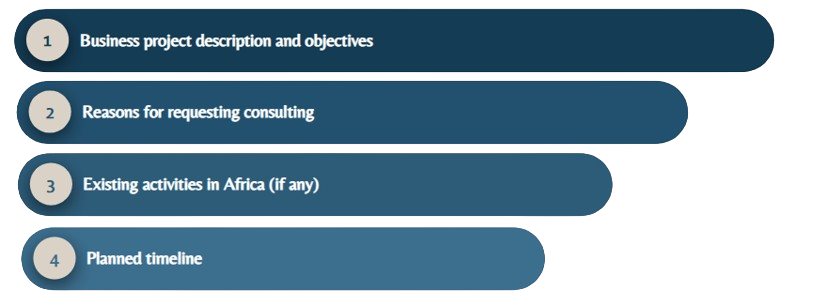
Before applying for funding, companies must:
- Ensure they meet eligibility criteria
- Prepare basic company data (legal form, turnover, employees)
- Identify a suitable consultant who is BAFA-registered
At this stage, no consulting should begin — otherwise the costs cannot be subsidised. Deutschland startet
2. Submit the BAFA Application Online
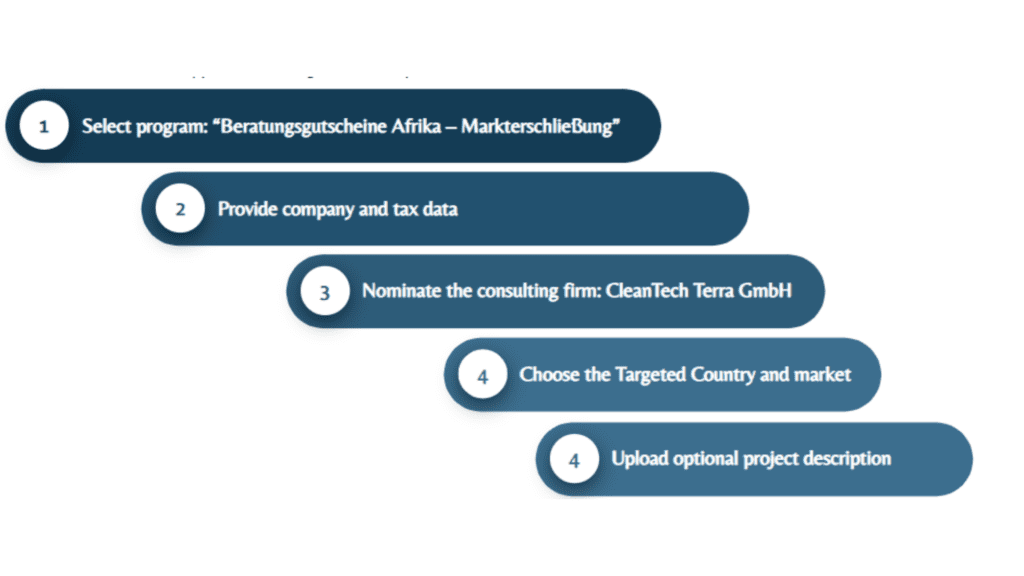
The official portal is provided by BAFA. Companies submit their application with:
- company details
- planned consulting scope
- consultant information
This occurs before any services are undertaken.
The client submits the application through the BAFA portal:
3. Review and Decision
BAFA or a designated Leitstelle (regional grant office) reviews the application for compliance. Once approved, the company receives an informational approval letter confirming eligibility.
4. Conduct the Consulting
After approval, the consultant and company work together to complete the consulting engagement. The consultant prepares:
- analysis reports
- recommendations
- documentation of sessions
This phase must be conducted before reimbursement.
5. Submit the Verwendungsnachweis (Proof of Use)
After consulting is complete, the company submits a final report and proof of costs to BAFA. Required documentation typically includes:
- completed consulting report
- invoices and proof of payment
- bank statements
- any supporting forms
Reimbursement and Payment
Once the Verwendungsnachweis is accepted:
- BAFA transfers the subsidised amount to the company
- The company retains ownership of the full consulting outcome
- No repayment is required as long as conditions are met
The reimbursement rate and maximum amount depend on location and current program rules.
| Consulting Topic | Maximum Daily Rate(15 working days) | Maximum Eligible Expenses | Maximum Subsidy (85%) | Client Net Cost (15%) |
| Market analysis, market research, business partners and local contacts, customs/import regulations, logistics and transport | up to €864 net / day | €12,960 | €11,016 | €1,944 |
| Business-case calculation, certifications and standards, development of a sales/distribution structure | up to €1,080 net / day | €16,200 | €13,770 | €2,430 |
| Financing, financing negotiations, establishment of a subsidiary, legal framework conditions | up to €1,296 net / day | €19,440 | €16,524 | €2,916 |
Important Rules and Conditions
- Funding is not retroactive — services must occur after approval.
- The consultant must be listed in BAFA’s official database.
- Only completed, documented, and actionable consulting qualifies.
- Companies must observe the de-minimis rule on total state aid received.
Who Benefits from the Programme?
BAFA Consulting Vouchers are widely used by:
- established SMEs
- start-ups
- companies preparing strategic pivots
- businesses exploring new markets
- organisations seeking specialised advice on regulatory or organisational topics
Because the programme lowers the financial barrier to expert consulting, it helps businesses make better-informed decisions and improve competitiveness.
Conclusion
The BAFA Consulting Vouchers programme is a central tool of German SME support policy. It provides state-subsidised consulting that is tailored, documented, and strategic — enabling companies to access professional expertise without bearing the full cost.
By covering a significant share of consulting fees and structuring the process through clear application, consultancy, and proof-of-use stages, BAFA helps SMEs:
- strengthen management decisions
- plan market strategies
- optimise operations
- and pursue growth with professional advice backed by the government
This programme helps bridge the expertise gap and allows German companies to elevate their competitiveness through high-quality consulting services.
